Stereogram Software
Create Stereograms on Windows and Macintosh.


(QuickTime Recommended)


Mac OS 9

(Does not include all features)

3D Maker Homepage
Click here to learn more about 3dMaker.

Anaglyph Software
Click here to learn more about using 3dMaker for creating Anaglyphs.

PC/MAC 3DMF Software
Click here to learn more about using 3dMaker as a 3DMF tool.


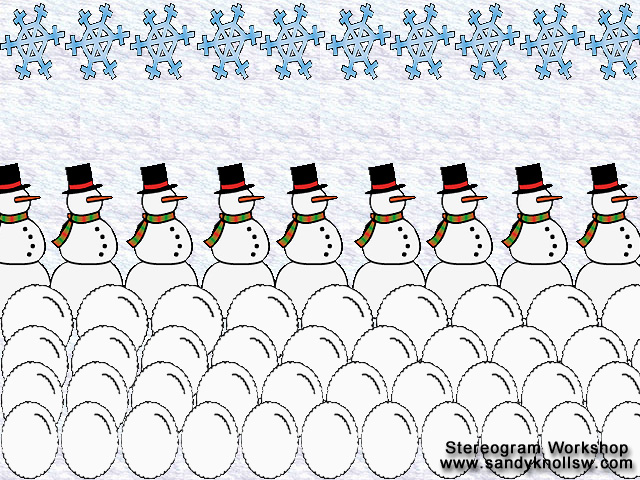
stereogram picture make in 3d maker

Stereogram Timeline
 
1960
Julesz, B. Binocular depth perception of computer generated patterns. Bell Systems Technical Journal 39, 1125-1162. (First article considering RDSs)
1962
Julesz, B. and Miller, J. E. (1962) Automatic stereoscopic stereogram presentation of functions of two variables. Bell System Technical Journal. 41:663-676; March. Thimbleby (1990) refers to this article: "Julesz and Miller were the first to show clearly that a sense of depth could arise purely from stereopsis, without relying on other cues such as perspective or contours. they used random patterns of dots which, although meaningless to single eye viewing, nevertheless created a depth impression when viewed in a stereoscope."

During the 1960s, a stereogram researcher named Bela Julesz was the first to use computer-generated 3-D images made up of randomly placed dots to study depth perception in human beings. Because the dot pictures did not contain any other information, like color or shapes, he could be sure that when his subject saw the picture it was 3-D only.

In the years that followed, other people continued using random dot stereogram pictures in their work; many of them were graduate students who studied with Julesz. With time they found new and better ways to create these interesting illusions.

1963
Julesz, B Stereopsis and binocular stereogram rivalry of contours. Journal of Optical Society of America 53, 994-999. (First article which was accepted in a major US journal)
1964
Julesz, B. Binocular depth perception without familiarity cues. Science 145, 356-363. (First stereogram paper which was accepted in a major international journal)
1965
Bela Julez, "Textured and Visual Perception," Scientific American, Feb. 1965. A stereogram article on stereo dot pictures. [George J Valevicius]
1966
N. A. Valyus. Stereoscopy. Focal Press, London and New York. 426 pp. (I have not seen this book, but Boyer,1990 refers to it to say that Stereographic paintings are almost beyond possibility.)
1968
Bela Julez. "Experiment in Perception," Psychology Today, July 1968. Cover story with a full page graphic and a few smaller ones.
1971
Bela Julesz. Foundations of Cyclopean Perception. Chicago: Univ. of Chicago Press. I have not seen this book, but Kinsman,1992 mentions it: "Julesz (1971) describes photographic techniques producing random dot stereograms in use in the early 1950s.... Since Julesz, in 1960, was the first to employ a computer to generate random dot stereograms, many would consider him the person most responsible for their popularity today.... Anaglyphs of random dot stereograms... are presented in the back of Julesz's book, and a pair of the (half-red/half-green) glasses required to view them is tucked inside the back cover."
1966
Julesz, B. Binocular disappearance of monocular stereogram symmetry. Science 153, 657-658. (Disparity cues can be more powerful than monocular from cues)
1971
Dr. Bela Julesz in "Reading from Scientific American - Image, Object and Illusion" by W.H. Freeman Publisher ISBN 0-7167-0505-2 (1971). [Bob Easterly]
1976
Marr, D. and Poggio, T. (1976), Cooperative computation of stereo disparity, Science, 194:283-287; October 15. Thimbleby (1990) refers to this article: "[They] discuss stereogram computational models of the visual processes that are involved in interpreting random dot stereograms."
1977
Bela Julesz. Foundations of Cyclopean Perception. University of Chicago Press, Chicago. xiv, 406 pp. I assume this is the same book as the 1971 book referenced by (Kinsman,1992). I think Boyer gave the wrong publication date. Of the book, Boyer writes:

"The random-dot stereogram is a very inspiring demonstration of the sophistication and complexity of the information-processing which occurs in everyday human vision.... The first extensive studies of random-dot stereograms were accomplished by Bela Julesz and his colleagues on large and expensive computers, using professional programmers, at the Bell telephone Laboratories." (Boyer,1990)

1979
Marr, D. and Poggio, T. (1979), A computational theory of human stereogram stereo vision, Proceedings Royal Society of London, B204, 304:328. Thimbleby (1990) refers to this article: "[They] discuss computational models of the visual processes that are involved in interpreting random dot stereograms."
1983
Schor & Cuiffreda, editors. Vergence Eye Movements: Basic & Clinical Aspects. One chapter, by Christopher Tyler including genuine SIRDS. Interestingly, he doesn't say he invented them. He just calls them "a new type of stereogram autostereogram designed for free fusion without the need for a stereoscope or anaglyph glasses". Then he says the basis is the repetition of a random pattern and refers to Tyler & Chang, 1977, Vision Res, #17. [Dan Richardson]
1985
Paul S. Boyer. Stereographic stereogram technique for illustrating geologic specimens. New Jersey academy of Science, Bulletin, volume 39, no. 2, pp. 83-91. I have not seen this article, but Boyer,1990 refers to it when speaking of the DIN 4531 stereogram format.
1986
L. L. Kontsevich. "An Ambiguous Random-Dot Stereogram Which Permits Continuous Changing of Interpretation," Vision Research, Vol. 26, No. 3, pp. 517-519. I have not seen this article, but Kinsman,1992 mentions it: "Kontsevich (1986) describes a technique for making a series of tiles." Kinsman presents a "similar stereogram" that is a SIRDS. If so, this would be the first SIRDS I am aware of.
1987
Paul S. Boyer. Constructing true stereograms on the Macintosh. The Journal of Computers in Mathematics and Science Teaching, volume 6, no. 2, pp. 15-22. (I have not seen this article, but Boyer,1990 refers to it as a detailed article describing computer stereography.)
1988
Falk, Brill and Stork produce the "Seeing The Light" stereogram image that Dyckman referenced in his Stereo World article. [Dan Richardson]
1988
J. Ninio and I. Herlin. "Speed and Accuracy of 3D Interpretation of Linear Stereograms, Vision Research, Vol. 28, No. 11, pp. 1223-1233. I have not seen this article, but Kinsman,1992 mentions it: "Ninio and Herlin (1988), and Slinker and Burton (1992), experimented with stereograms containing complex patterns [triangles, lines, blotches, and even images] in their initial noise fields."
1989
Rocca and Stork, Behavior Research Methods, Instruments and Computers, 1989, might be vol 21 number 5. Demonstrats a little Mac program they wrote to generate SIRDS from MacPaint files. [Dan Richardson]
1990
Paul S. Boyer, Professor of Geology, Fairleigh Dickinson University, "Random-Dot Stereograms -- Creating a stereogram Psychological Phenomenon," STEREO WORLD, March/April 1990. Creating SIRDS on the Mac.
1990
Tyler, C. W. and Clarke, M. B. (1990) The autostereogram. SPIE Stereoscopic Displays and Applications 1258: 182-196. Thimbleby (1990) refers to this article: "Recently, however, Tyler and Clarke realized that a pair of random dot stereograms can be combined together, the result being called a single image random dot stereogram (SIRDS) or, more generally, an autostereogram.... [They] described a simple but asymmetric altorithm, which meant, for example, that some people can only see the intended effect when the picture is held upside-down."
1990
Dan Dyckman, "Single Image Random Dot Stereograms," STEREO WORLD, May/June 1990. "I was recently surprised when a friend of mine ... showed me a random-dot-stereograph that consisted fo a single image, rather than the usual stereo pair. To view the stereogram image, one fused two marks within the image, and would see the words SEEING THE LIGHT."

"Interested readers might consider creating poster-sized images using this technique, or experimenting with supplementary gray-level or color values for each pixel. And, if any reader knows who invented this technique for single image random dot stereograms, or who created the SEEING THE LIGHT image, please drop a note to this magazine."

1991
Prior to June 1991 a company named Pentica Systems, Inc (One Kendall Square, Building 200, Cambridge, MA 02139, Tel. 617-577-1101, Tom Baccei - President) published an advertisment, "Pentica Loves Puzzles," with a SIRDS image in it. The magazine may have been EDN--I don't remember.
1991
About June 3, 1991, Pentica mails an information packet to those responding to the add. In the information Pentica sent to those responding to the ad, they say, "We discovered ... the technique for generating it in STEREO WORLD." Four SIRDSs accompany the information, marked "images (c) 1990 by Dan Dyckman."
1991
June 13, 1991, N.E. Thing Enterprises, (One Kendall Square, Building 200, Cambridge, MA 02139) also mails a stereogram flyer to those responding to the Pentica ad. The N.E.Thing address and the Pentica address are the same, as well as the postal meter number (FMETER 8010560) for the two mailings. The flyer states, "from the people who created the Pentica Loves Puzzles Ad.... Because of the unbelievably enthusiastic response to our random dot stereogram featured in the 'Pentica Loves Puzzles' ad, we are rushing you this advance notice of our latest 3D mindbenders." They offered 3 posters, World's Hardest Maze, The Third Eye, Training Wheels, and a 1992 Calendar.
1992
Andrew A. Kinsman, Random Dot Stereograms, Kinsman Physics, 1992. First printing October 1992. "This history of the stereogram is a bit elusive. It appears to be intertwined with anaglyphs, lenticular photographs, and stereoscopic photographic techniques. Charles Wheatstone described stereoscopy in 1832. In 1851 the the London Society of Arts held the Crystal Palace Exhibition, which six million people attended and potentially witnessed Sir David Brewster demonstrate the stereogram stereoscope. Stereoscopes became popular as a result. Kahn (1967), in The Codebreakers, references an article by Herbert C. McKay, written in the late 1940s, on how to manufacture simple stereograms with a typewriter for encryption purposes.... Julesz (1971) describes photographic techniques producing random dot stereograms in use in the early 1950s. History seems to have recorded no particular inventor of stereograms. It is quite probable that soon after parlor-style stereoscopes became popular someone took a photograph of a camouflaged hunter with a stereo camera. The subject in the resulting picutre might be difficult to identify. Viewed stereoscopically with the rest of their collection, the subject would become obvious."
1992
"This unique synthesis of computer technology and fine art began simply as an idea between two creative individuals in 1992. Paul's art background and Mike's computer genious proved to be the perfect combination of stereogram talents. Several hundred man hours later, in a remote region of California, came the first public exposure to Holusion(TM) 3D Prints. And so NVision Grafix was born." (NVision Grafix flyer introducing Calypso Reef, 1993.) "Micro Synectic was Mike Bielinski is NVision...NE Thing and Micro Synectics are listed in the StareEO demo, because Mike Bielinski wrote it for NE Thing." (CompuServe messages from Dan Richardson) "The images are the creation of NVision Grafix, a Texas-based firm owned by two former fraternity brothers, Paul Herber and Mike Bielinski. They developed the Holusion technology while making a poster of the B-2 bomber for the company where Herber worked as an engineer. The posters were a huge hit, and soon, Herber and Bielinski had abandoned their jobs to start up NVision: Herber is the artist, and Bielinski is the computer whiz.... As NVision has grown, though so has it's competition. Computer expert Tom Baccei has created his won "high-tech, three-dimensional art form" and is marketing the stereogram images on books, posters, calendars, puzzles and cards." (Nicole Brodeur, Orange County Register. As reprinted in The Daily Herald, March 22, 1994)
1993
N.E. Thing begins patent process on several RDS algorithms. "Salitsky dot" algorithm and the algorithm to produce an RDS that looses it's colors when viewed in 3D are apparently two algorithms. I have not seen the patent applications, but the law requires that they discuss "prior art." If someone could get copies of these applications, it would not only describe the algorithms in detail, it would present a history of SIRDS, to the degree that N.E. Thing was aware.
1993
Harold W. Thimbleby, Stuart Inglis, and Ian H. Witten, "Displaying 3d Images: Stereogram Algorithms for Single Image Random Dot Stereograms," University of Waikato, Hamilton, New Zealand, published on the Internet. I believe Stuart mentioned it was being published in an IEEE journal in 1994. I've forgotten which one and when. [See next entry]
1994
Harold W. Thimbleby, Stuart Inglis, and Ian H. Witten, "Displaying 3d Images: Algorithms for Single Image Random Dot Stereograms," published IEEE Computer, Oct. 1994
1995
Dan Richardson, "Create Stereograms on your PC". Dan provides a primer and a collection of PC programs supplied on a 3.5". Excellent pictures.
1996
Waktins and Mallette, "Stereogram Programming Techniques". The authors provide a nice collection of stereogram information, including: stereogram creation, raytracing, anaglyphs and hand made stereograms. 
2004
SandyKnoll Software releases 3d Maker version 3.2.1 - the latest version of their Stereogram Software.

3D Maker Homepage
Click here to learn more about 3dMaker Stereogram Software.

PC & Mac Shareware Game Downloads  Venture  -  Championship Connect Four  -  Mancala 2000  -  Stack'em 3D  -  Ruins II
PC & Mac Shareware Downloads  -  Metes and Bounds  -  Anaglyph Software  -  PC/MAC 3DMF Editor

3D Maker Stereogram Software is Copyright(C) 1999-2007 by Sandy Knoll Software